
Hard Truths and Hope: When the Helpers Need Help
The Reality We're All Living In Is No Fun. We See You on the Struggle-Bus, and We're Right There With You.
If you're reading this feeling exhausted, questioning whether you can sustain another quarter of "doing more with less," or wondering if anyone truly understands the weight you're carrying—you're not alone.
The social impact sector is hemorrhaging right now. The ripple effect of the current administration’s cuts to federal funding for programs fighting to end hunger, disease, homelessness, and climate change, aren’t drops in the buckets of our own hometowns. They are tidal waves of despair.
What the average American doesn’t know about the nonprofit sector is that, as of 2024:
There are 1.8 million nonprofits in the US
They employ 12.5 million people annually, or roughly 10% of the American workforce
Nonprofits CONTRIBUTED over $1.4 TRILLION to the US economy
That’s a GDP contribution of over 5%
Don't believe us? Check this chart out that details the impact the sector has on the US economy.
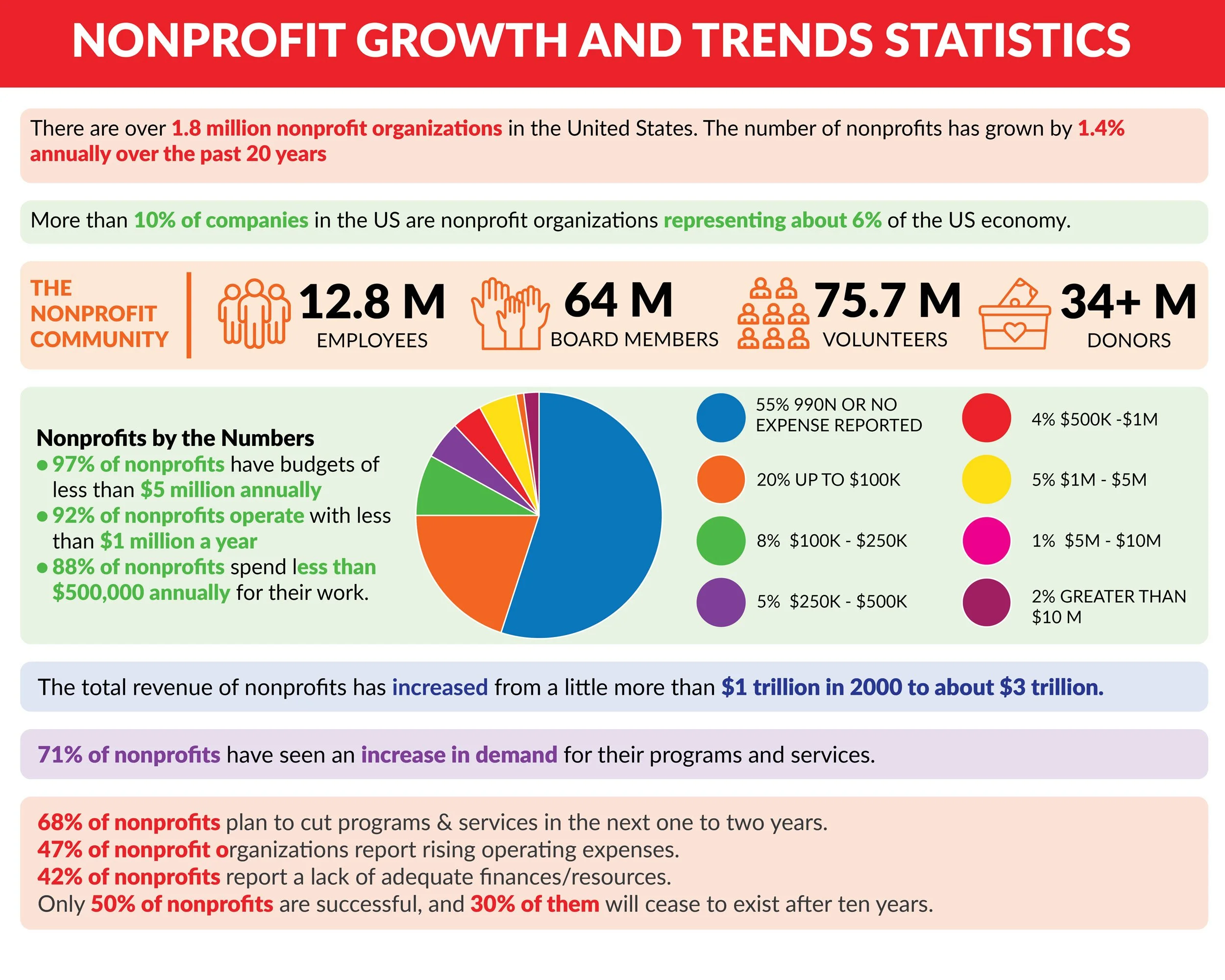
Source: Nonprofit Hub
When you take a tire iron and a lighter to slash and burn a sector with this much impact on the economy, what you’re actually doing is setting aflame our communities, nonprofit employees, and their service providers.
Who thought THAT was a good idea?!
As a result, funding is tighter, needs are greater, and leaders like you are burning out at unprecedented rates. People are being laid off, nonessential services are being cut, and organizations that are failing are merging with others. And here's something we've never shared before: we're struggling too.
The social impact ecosystem has trained us all to suffer in silence. Nonprofits are told to be grateful for scraps, to never admit when they're drowning because that might jeopardize the next grant or donor relationship. Social enterprises feel pressure to prove their impact while also proving their profitability.
And those of us who serve this sector? We're supposed to have all the answers, to be the stable ones with our act together.
We've been conditioned to believe that struggle is noble, that financial stress is just part of working for good, and that admitting difficulty means something’s wrong with us. But what if this narrative is not just wrong—what if it's actively harmful?
What if the very culture that demands we be perpetually grateful and never vulnerable is the same culture that's burning out our best leaders and weakening the sector's ability to create real change?
Our Story: When the Helpers Need Help
For the first time in our company's history, we had to make layoffs this summer. We've spent years helping nonprofits and social enterprises navigate financial challenges, and suddenly we found ourselves making the exact impossible decisions we help our clients through.
It was humbling. It was heartbreaking. And it was necessary.
We're sharing this not for sympathy, but for solidarity. Because if a for-profit company that specializes in nonprofit and social enterprise financial health isn't immune to these pressures, then no leader should feel alone in their struggles right now.
The Warning Signs We Missed
Looking back, the signs were there. Client renewals stretched longer than usual. New client inquiries slowed. Clients asked for reduced fees or shorter contract terms. The general economic uncertainty that everyone was whispering about finally reached our door. But like so many nonprofit leaders, we kept believing that passion and hard work would somehow be enough to weather any storm.
We fell into the same trap we warn our clients about: we assumed our mission would protect us from market realities. Even as a for-profit company, we thought that because we were doing work that genuinely helped social impact organizations become more sustainable—we were somehow immune to the forces affecting everyone else.
The irony isn't lost on us.
Here we are, the for-profit company that helps social impact organizations build financial resilience, learning firsthand why sometimes, no matter how much you’ve got in reserves, the external environment can wreak havoc on your business.
The Conversations We Didn't Want to Have
The hardest part wasn't the spreadsheets or the budget cuts. It was the conversations.
Sitting across from team members who trusted us, who believed in our mission, who had turned down other opportunities to be part of something meaningful. How do you tell someone that their position is being eliminated not because of their performance, but because of circumstances beyond anyone's control?
We found ourselves saying the same words we'd heard from countless executive directors over the years: "This isn't about you. This is about sustainability. This is about ensuring we can continue serving our mission long-term."
The words felt different coming out of our mouths than they had when we'd helped others craft them.
Every social impact leader who's ever had to make impossible staffing decisions knows this feeling. The way your stomach drops when you realize there's no creative accounting solution this time. The sleepless nights running through every alternative scenario. The weight of knowing that your decision will ripple through someone's life in ways you can't control or fix.
What We Learned About Ourselves
This experience stripped away any remaining illusions we had about being different from our clients. We aren't the wise advisors looking down from a place of financial security. We are fellow travelers on the same uncertain path, subject to the same forces, vulnerable to the same pressures.
It is a lesson in humility we didn't know we needed.
We also learned something about resilience. Not the toxic positivity kind that nonprofits are so often expected to display, but real resilience—the kind that comes from facing hard truths directly and making difficult decisions with as much grace as possible.
We discovered that transparency, even when it feels risky, creates deeper connections than any polished success story ever could. The clients and colleagues who reached out after we shared our situation weren't offering pity—they were offering solidarity.
"We've been there." "Thank you for saying what we all feel." "It helps to know we're not the only ones."
The Myth of Struggling for Good
There's something deeply problematic about a culture that has romanticized struggle across the entire social impact ecosystem. Nonprofits are expected to prove their worthiness through financial stress. Social enterprises must justify their dual bottom line while operating on shoestring budgets. And those of us who serve this sector—whether as consultants, vendors, or service providers—are supposed to charge less because, "it's for a good cause."
This mythology doesn't serve anyone. It doesn't serve the communities these organizations are trying to help, who deserve stable and well-resourced support. It doesn't serve the teams working within them, who deserve fair compensation and job security. And it certainly doesn't serve the leaders who are quietly burning out, convinced that their struggle is somehow virtuous.
When we had to make layoffs, it initially felt like failure. Like we had somehow betrayed the trust placed in us. But the more we talked to other leaders, the more we realized that our experience wasn't exceptional—it was typical. The exception would have been sailing through unaffected.
The Hidden Crisis of Social Impact Leadership
What became clear through our own crisis was just how many leaders across the social impact ecosystem are suffering in silence. The nonprofit executive director who hasn't taken a real vacation in three years because there's no one else who can handle the board meetings. The social enterprise founder juggling impact metrics and investor expectations while wondering if this month's revenue will cover payroll. The program manager doing the work of three people because "we just don't have the budget for more staff."
We've created an ecosystem where admitting struggle feels like weakness, where asking for help feels like failure, where the constant pressure to do more with less has become so normalized that we've forgotten it's not actually sustainable.
The mental health crisis among social impact leaders is real and urgent. We're losing talented, passionate people not because they stop caring about the cause, but because the ecosystem has made it impossible for them to care for themselves while caring for others.
The Cost of Silence
When we don't talk about these struggles openly across nonprofits, social enterprises, and the businesses that serve them, several things happen:
Isolation multiplies. Leaders assume their struggles are unique, personal failures rather than systemic issues affecting the entire social impact ecosystem.
Solutions remain hidden. If we don't acknowledge problems across nonprofits, social enterprises, and their support systems, we can't develop strategies to address them collectively.
Burnout accelerates. Without permission to be vulnerable, leaders push themselves past sustainable limits.
Innovation stagnates. Organizations in survival mode can't take the risks necessary for breakthrough thinking.
The mission suffers. Exhausted, under-resourced organizations simply cannot deliver their best work, no matter how passionate their people are.
What Changes When We Tell the Truth
Something powerful happens when leaders start being honest about their struggles. The shame lifts. The isolation breaks. Real solutions become possible.
When we shared our layoff story, we expected awkwardness, maybe some loss of confidence in our services. Instead, we found community. Other business owners reached out to share their own experiences. Nonprofit leaders thanked us for saying what they'd been feeling. Potential clients expressed more interest in working with us, not less, because they knew we understood their reality from the inside.
Truth-telling creates trust. Vulnerability creates connection. And connection is what our sector desperately needs right now.
The Path Forward
We're not suggesting that nonprofits should publicize every financial struggle or that leaders should process their stress publicly. But we are suggesting that the culture of silence and shame around organizational challenges is actively harmful to the people trying to create positive change in the world.
What if we created space for leaders across nonprofits, social enterprises, and mission-driven businesses to be honest about their struggles without it being seen as incompetence? What if we acknowledged that fighting for justice in an unjust system is inherently difficult work that requires unprecedented support? What if we stopped romanticizing struggle and started building structures that actually support sustainable leadership across the entire social impact ecosystem?
The social impact ecosystem needs leaders who are resourced, rested, and resilient. Leaders who can make decisions from a place of clarity rather than desperation. Leaders who can model the kind of sustainable practices we want to see in the world.
This doesn't happen by accident. It requires intentional culture change, starting with permission to tell the truth about what we're really experiencing.
You're Not Alone
If you're reading this and recognizing your own experience, know that you're not alone. Your struggles don't make you weak or uncommitted or unworthy of the work you're doing. They make you human, trying to do extraordinary work in difficult circumstances.
The system is not set up to support you the way you deserve to be supported. That's not your fault, and it's not your failure. But it is something we can change, together.
Whether you're facing layoffs, program cuts, funding uncertainty, or just the daily weight of carrying everyone else's hope when your own feels fragile—you're part of a community of people who understand exactly what that feels like.
And maybe, together, we can start building something different. Something that honors both the urgency of our missions and the humanity of the people carrying them forward.
What would it look like if we supported each other through the hard seasons instead of pretending they don't exist?
What would change if we created space for leaders to breathe instead of always holding their breath?
What becomes possible when we stop suffering in silence?
We're about to find out.
